
Makro’s Shopify Recap 010: Updates on Multi-Entity Selling, Same-Country Entities, and the End of Expansion Stores

Shopify has introduced a major update for enterprise merchants managing multiple legal entities, making it easier to consolidate operations, simplify payments, and reduce reliance on expansion stores.
copy link

Multi-Entity Selling, Same-Country Entities, and the End of Expansion Stores

Shopify just made one of its biggest structural changes for enterprise retailers in a while. And if you’re running a business with more than one legal entity, this is the one to read first.

Here’s the short version of what we’ll cover: what actually changed, who it’s for, and the things worth thinking through before you touch your setup.

Multi-Entity Architecture and Payments

These changes reshape how enterprise brands can structure their Shopify operations, clearing away the setups that used to push multi-entity businesses into expensive workarounds

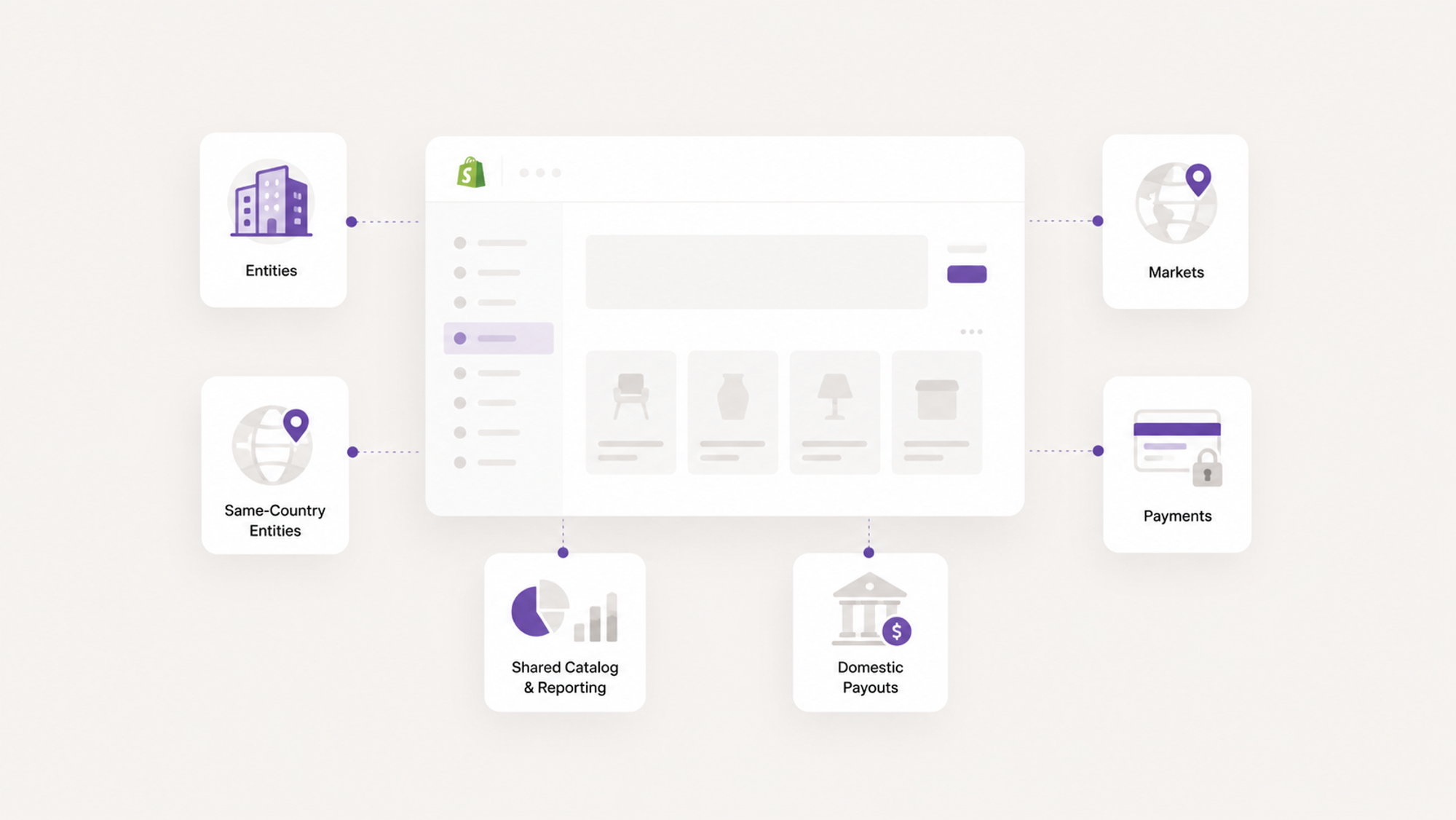
What’s New at a Glance:

  • Sell from Multiple Legal Entities in One Shopify Store
  • Same-Country Multi-Entity Support
  • Domestic Card Processing Per Entity
  • Multiple Domestic Payout Currencies
  • Key Constraints Around Shopify Payments, Subscriptions, and Entity Mapping
1. Sell from multiple legal entities in a single store

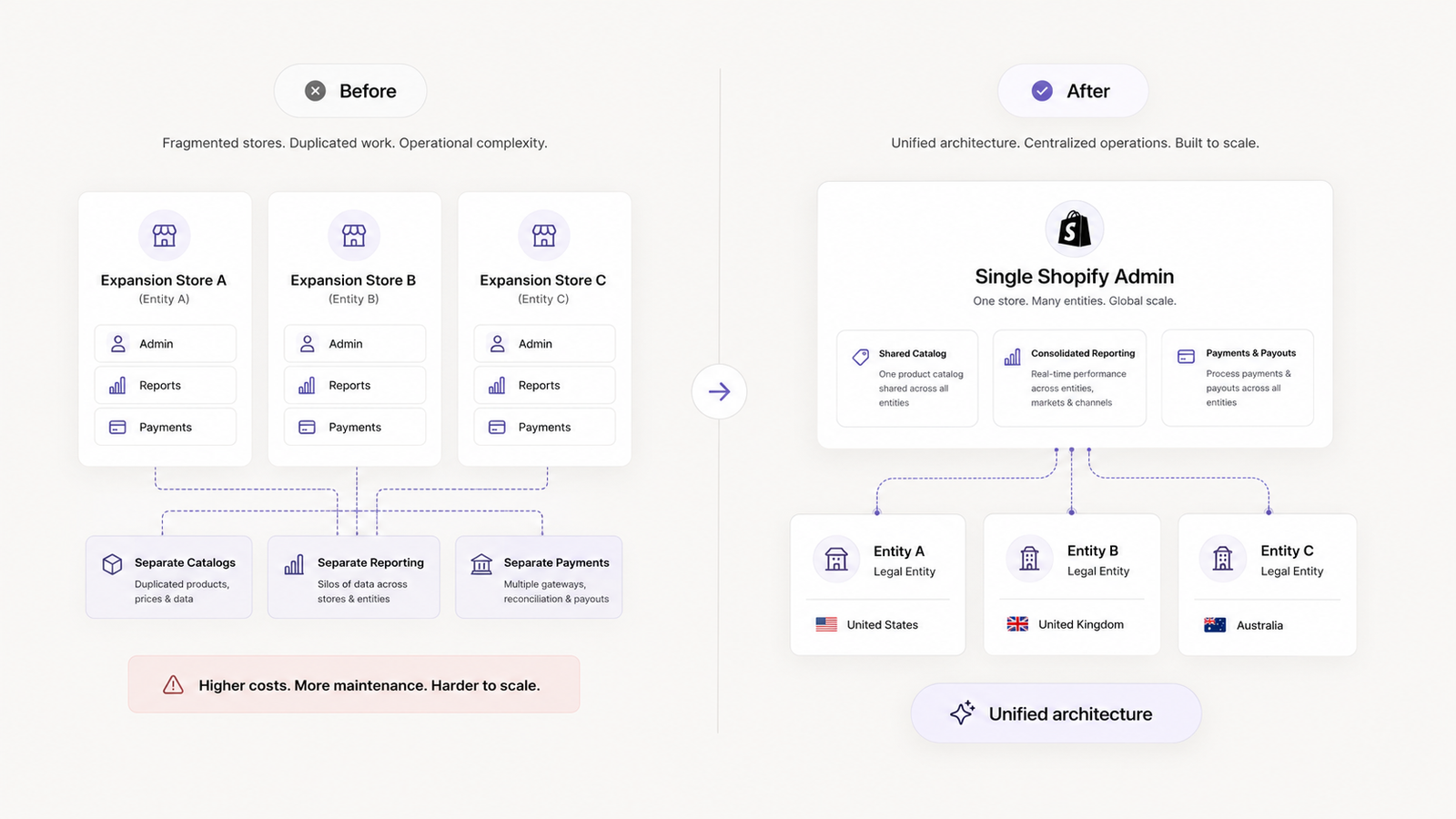
For years, keeping your entities legally separate on Shopify meant keeping everything else separate too. Separate subscriptions, separate admins, separate data, separate everything.

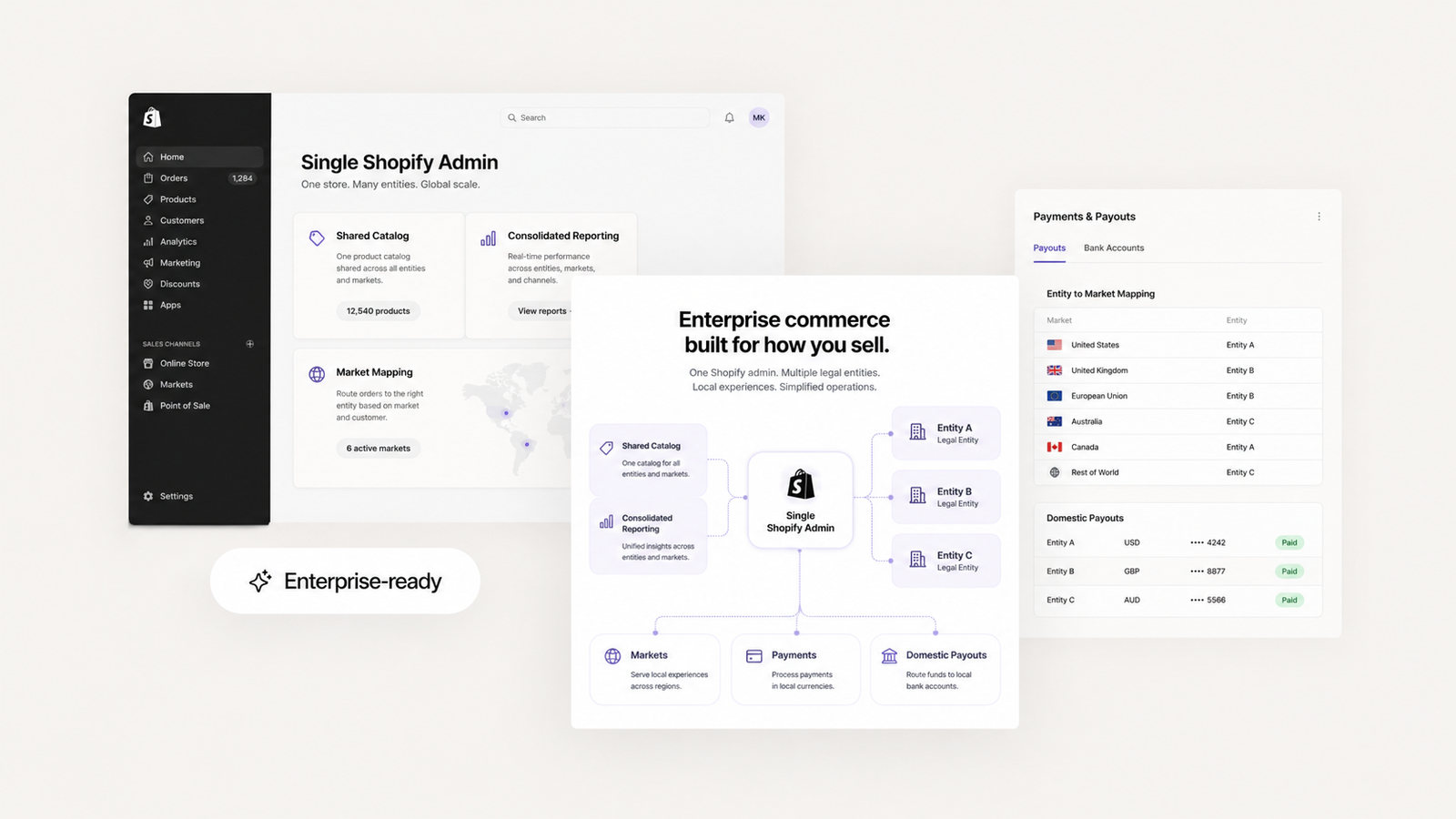
Not anymore. Shopify now lets you run multiple legal entities from inside one store using Shopify Payments. Your team works from a single admin. Your catalog is shared. Your reporting is consolidated. And your legal structure stays exactly as it is.

This one is available on Shopify Plus and the Shopify Enterprise Commerce plan.

How to turn it on: head to Settings > Payments, add a Shopify Payments account, pick your business entity, then connect it to the right market under Settings > Markets.
2. Same-country multi-entity support

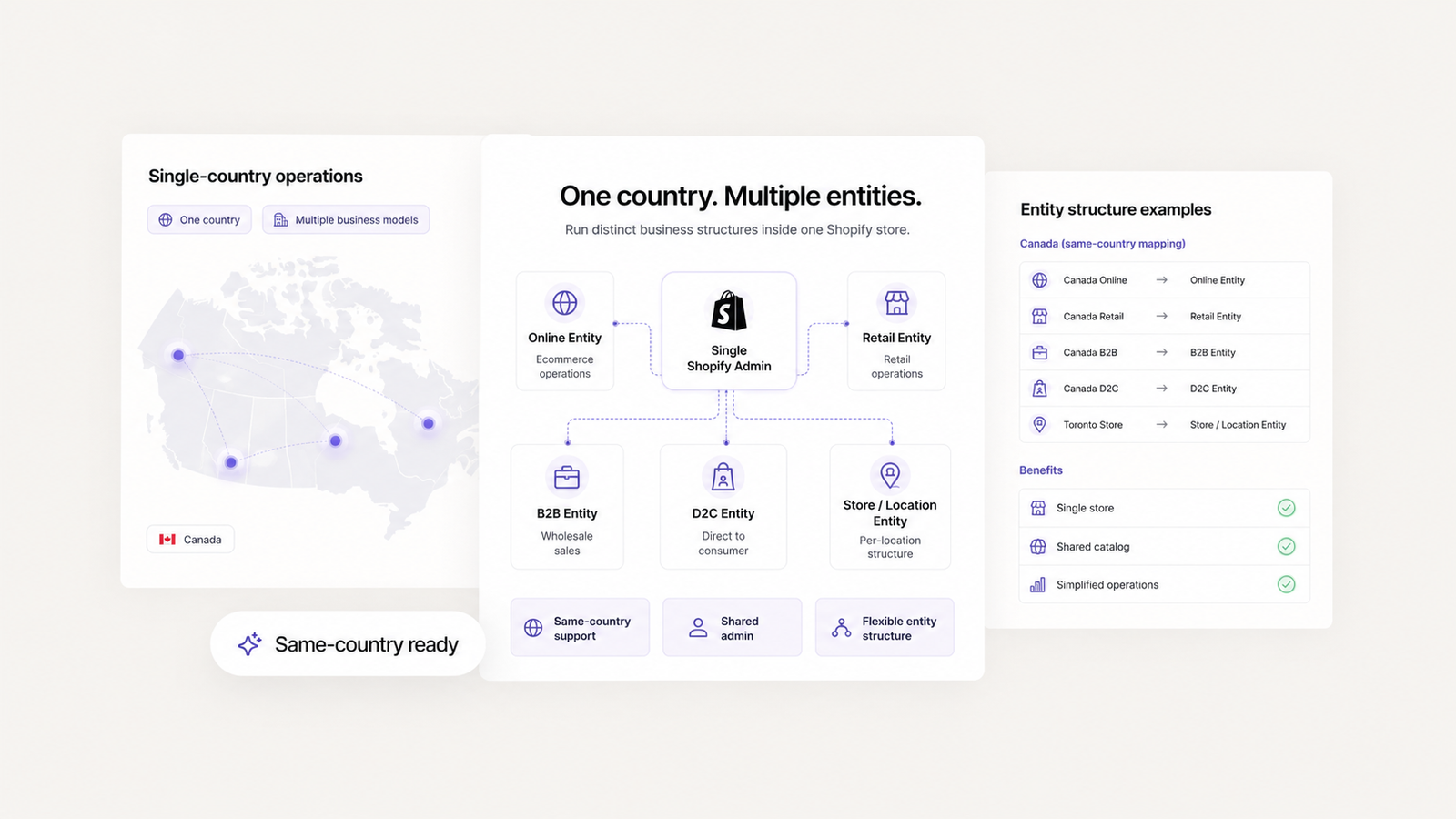
This is the newest piece, and for domestic operations it might be the most important one. Shopify now supports separate legal entities inside the same country, not just across borders.

So you can keep distinct entities for your online and retail operations, run a separate entity per retail location, or split B2B and D2C into their own entities. All in the same country, all from one store.

If you’ve grown through acquisition, or you structured regionally for liability or compliance reasons, this clears a barrier that’s been there since the beginning. The same-country structures Shopify supports right now include online and retail splits, per-location entities, and separate B2B and D2C entities.
3. Domestic card processing per entity

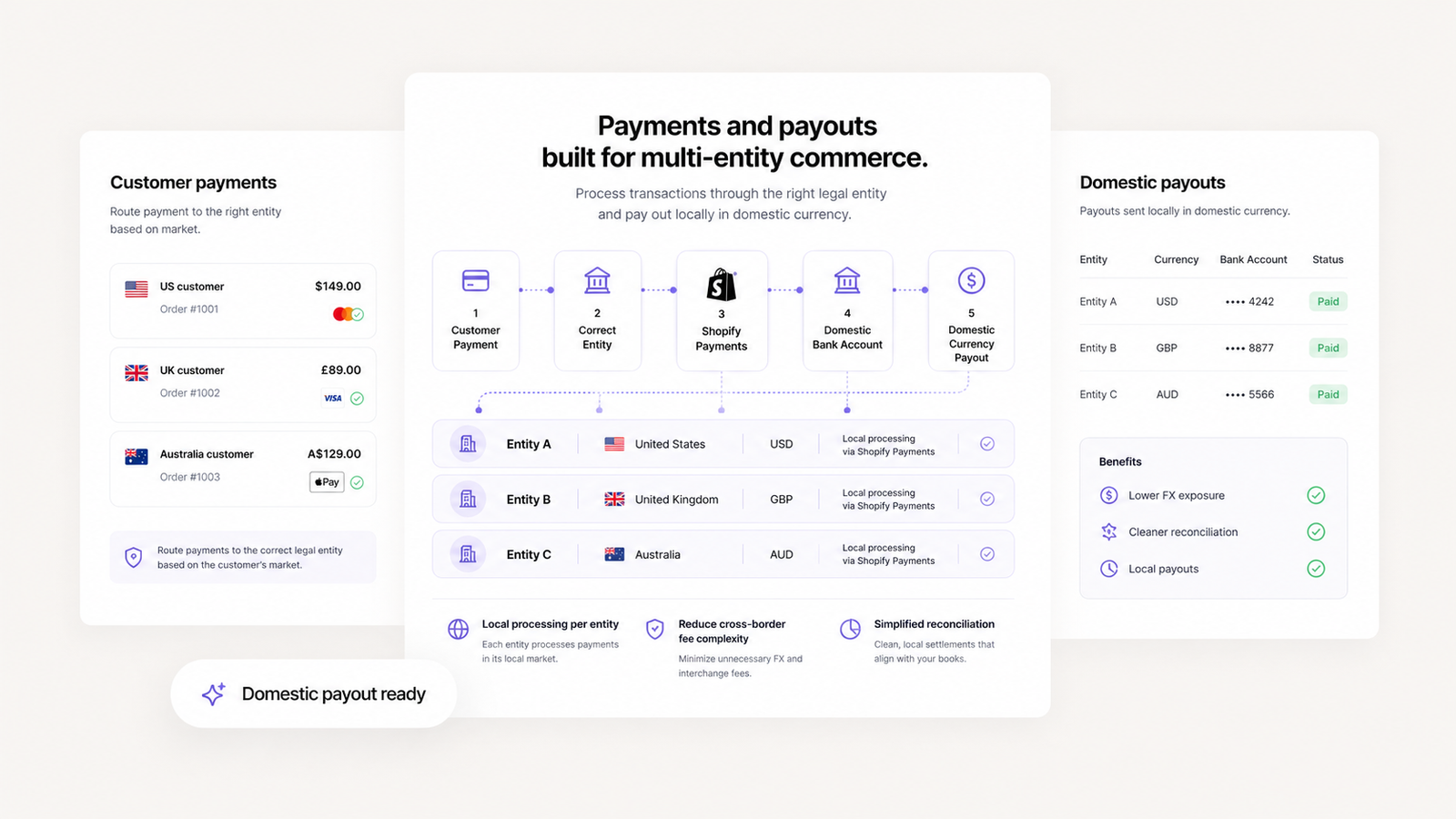
Each entity can now process payments in its own domestic currency through Shopify Payments, instead of routing everything through one primary entity.

The practical upside is simple. The international card fees and FX fees that used to kick in whenever a transaction crossed entity lines no longer apply. If you’re running high volume, that’s a real cost saving, not a rounding error.
4. Multiple domestic payout currencies

Each entity also gets paid out to its own domestic bank account, in its own domestic currency.

That means no more manual currency consolidation or reconciliation gymnastics at month end. Revenue lands in the right entity’s account on its own, which makes life a lot easier if you manage payroll, compliance, or reporting separately by entity.

What to Know Before You Make the Move

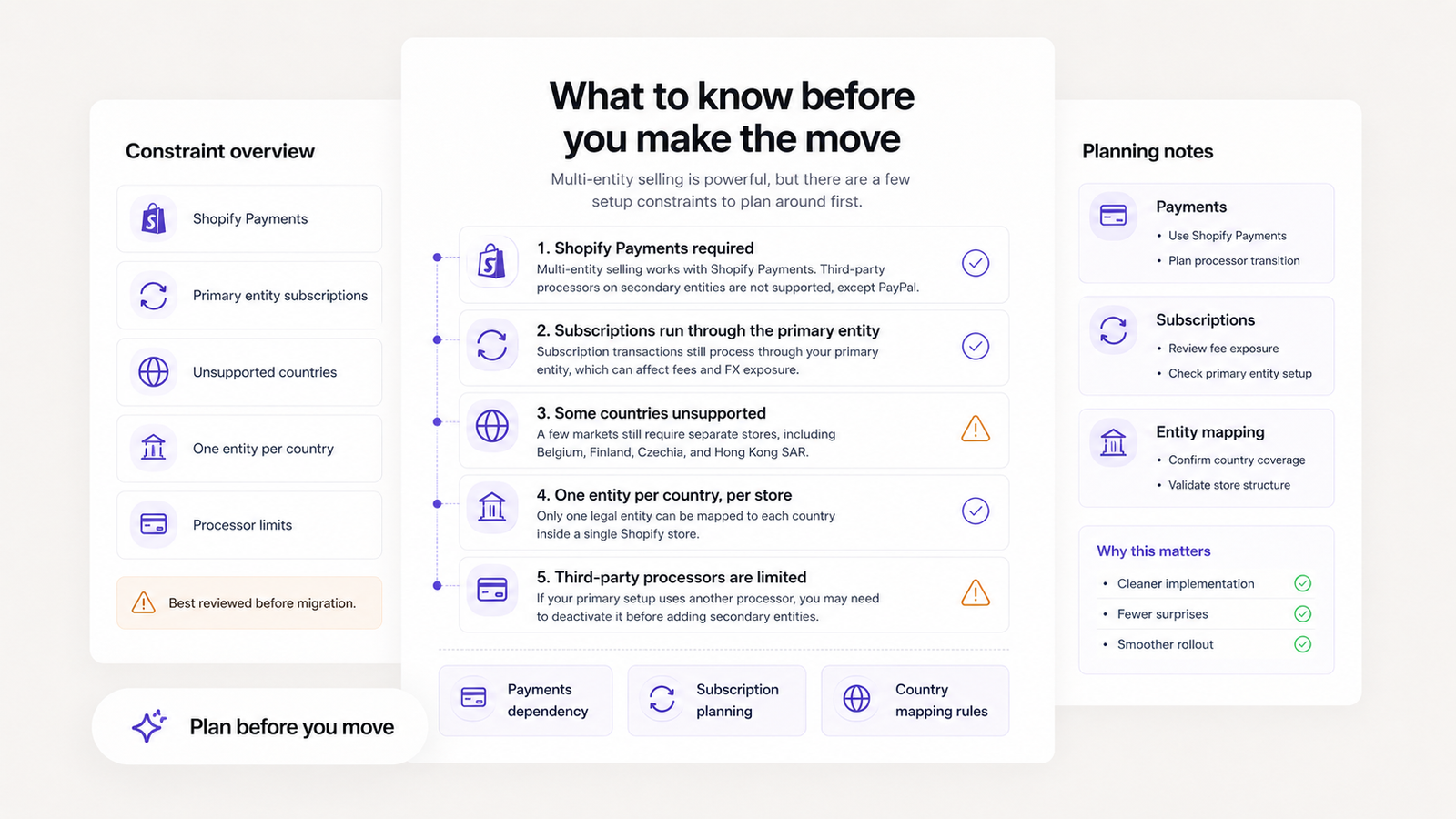
Multi-entity support is a big step forward, but there are some real constraints to plan around before you change anything.
i. You’ll need Shopify Payments

Selling from multiple entities only works with Shopify Payments. So if your primary entity is currently on a third-party processor, you’ll need to deactivate it before adding Shopify Payments to any secondary entity.

Third-party payment methods on secondary entities aren’t supported either, with one exception: PayPal.

ii. Subscriptions still run through your primary entity

If subscriptions are a meaningful part of your revenue, keep this in mind. Every subscription payment processes through your primary entity, no matter which entity the customer is mapped to.

Depending on where your customers and your primary entity sit, international card fees and FX fees can still apply.

Worth planning for before you move a subscription-heavy audience over.

iii. A few countries aren’t supported yet

Multi-entity selling covers a wide list of countries, including the US, Canada, UK, Australia, Japan, Singapore, and most of Europe. A handful aren’t supported yet, though: Belgium, Finland, Czechia, and Hong Kong SAR.

If your structure includes entities in those markets, they’ll need to stay as separate stores for now.

iv. One entity per country, per store

You can only map one entity per country within a single store. So if you run two distinct legal entities in the same country under different structures, they can’t both live in the same Shopify store at the same time.

Want the Full Breakdown? Get the Deep-Dive Here

If you want the complete picture in one place, we pulled everything in this update into a deep-dive guide you can keep on hand.

It walks through how to set up multiple entities step by step, the same-country structures Shopify supports, how payments and payouts work per entity, and every constraint worth planning around before you move.

Read the deep-dive guide

Is This Update Right for Your Business?

For enterprise brands juggling multiple legal entities, this is a meaningful one. It strips out infrastructure complexity that has pushed growing businesses into fragmented, costly Shopify setups for years.

The catch is that the Shopify configuration is only half the job. Getting your entity-to-market mapping right, planning around the payment and subscription constraints, and keeping the customer experience consistent across a consolidated structure is where the real implementation work lives.

If you’re on Shopify Plus with multiple legal entities, or you’re thinking about restructuring ahead of expansion, now is a good time to look at whether your current setup is costing you more than it should.

Related Work Worth a Look

A lot of this comes down to getting complex, enterprise-grade Shopify Plus builds right, especially for B2B and multi-structure brands. Here is some of how we have approached that:

  • NewPro Containers: a Magento to Shopify Plus migration built around a B2B trade portal and tens of thousands of SKUs. Read the case study
  • Ennis Fabrics: Rebuilding Shopify shipping Infrastructure - For a high-volume B2B supplier. Read the case study

Want a hand navigating the transition?

We build scalable, enterprise-grade Shopify Plus solutions for exactly this kind of structure.

Contact us and we’ll talk through what multi-entity support means for your specific setup, and how to get it right.

At Makro Agency, we’re excited to help enterprise merchants unlock these new capabilities, driving growth, innovation, and efficiency in 2026 and beyond.

Get Makro News & Advice straight to your inbox.

Subscribe to our newsletter and be the first to hear about what’s hot in e-commerce.
*
Thank you! Your submission has been received!
Oops! Something went wrong while submitting the form.

Read next:

June 11, 2026

Makro’s Shopify Recap 010: Updates on Multi-Entity Selling, Same-Country Entities, and the End of Expansion Stores

Shopify has introduced a major update for enterprise merchants managing multiple legal entities, making it easier to consolidate operations, simplify payments, and reduce reliance on expansion stores.

Multi-Entity Selling, Same-Country Entities, and the End of Expansion Stores

Shopify just made one of its biggest structural changes for enterprise retailers in a while. And if you’re running a business with more than one legal entity, this is the one to read first.

Here’s the short version of what we’ll cover: what actually changed, who it’s for, and the things worth thinking through before you touch your setup.

Multi-Entity Architecture and Payments

These changes reshape how enterprise brands can structure their Shopify operations, clearing away the setups that used to push multi-entity businesses into expensive workarounds

What’s New at a Glance:

  • Sell from Multiple Legal Entities in One Shopify Store
  • Same-Country Multi-Entity Support
  • Domestic Card Processing Per Entity
  • Multiple Domestic Payout Currencies
  • Key Constraints Around Shopify Payments, Subscriptions, and Entity Mapping

1. Sell from multiple legal entities in a single store

For years, keeping your entities legally separate on Shopify meant keeping everything else separate too. Separate subscriptions, separate admins, separate data, separate everything.

Not anymore. Shopify now lets you run multiple legal entities from inside one store using Shopify Payments. Your team works from a single admin. Your catalog is shared. Your reporting is consolidated. And your legal structure stays exactly as it is.

This one is available on Shopify Plus and the Shopify Enterprise Commerce plan.

How to turn it on: head to Settings > Payments, add a Shopify Payments account, pick your business entity, then connect it to the right market under Settings > Markets.

2. Same-country multi-entity support

This is the newest piece, and for domestic operations it might be the most important one. Shopify now supports separate legal entities inside the same country, not just across borders.

So you can keep distinct entities for your online and retail operations, run a separate entity per retail location, or split B2B and D2C into their own entities. All in the same country, all from one store.

If you’ve grown through acquisition, or you structured regionally for liability or compliance reasons, this clears a barrier that’s been there since the beginning. The same-country structures Shopify supports right now include online and retail splits, per-location entities, and separate B2B and D2C entities.

3. Domestic card processing per entity

Each entity can now process payments in its own domestic currency through Shopify Payments, instead of routing everything through one primary entity.

The practical upside is simple. The international card fees and FX fees that used to kick in whenever a transaction crossed entity lines no longer apply. If you’re running high volume, that’s a real cost saving, not a rounding error.

4. Multiple domestic payout currencies

Each entity also gets paid out to its own domestic bank account, in its own domestic currency.

That means no more manual currency consolidation or reconciliation gymnastics at month end. Revenue lands in the right entity’s account on its own, which makes life a lot easier if you manage payroll, compliance, or reporting separately by entity.

What to Know Before You Make the Move

Multi-entity support is a big step forward, but there are some real constraints to plan around before you change anything.

i. You’ll need Shopify Payments

Selling from multiple entities only works with Shopify Payments. So if your primary entity is currently on a third-party processor, you’ll need to deactivate it before adding Shopify Payments to any secondary entity.

Third-party payment methods on secondary entities aren’t supported either, with one exception: PayPal.

ii. Subscriptions still run through your primary entity

If subscriptions are a meaningful part of your revenue, keep this in mind. Every subscription payment processes through your primary entity, no matter which entity the customer is mapped to.

Depending on where your customers and your primary entity sit, international card fees and FX fees can still apply.

Worth planning for before you move a subscription-heavy audience over.

iii. A few countries aren’t supported yet

Multi-entity selling covers a wide list of countries, including the US, Canada, UK, Australia, Japan, Singapore, and most of Europe. A handful aren’t supported yet, though: Belgium, Finland, Czechia, and Hong Kong SAR.

If your structure includes entities in those markets, they’ll need to stay as separate stores for now.

iv. One entity per country, per store

You can only map one entity per country within a single store. So if you run two distinct legal entities in the same country under different structures, they can’t both live in the same Shopify store at the same time.

Want the Full Breakdown? Get the Deep-Dive Here

If you want the complete picture in one place, we pulled everything in this update into a deep-dive guide you can keep on hand.

It walks through how to set up multiple entities step by step, the same-country structures Shopify supports, how payments and payouts work per entity, and every constraint worth planning around before you move.

Read the deep-dive guide

Is This Update Right for Your Business?

For enterprise brands juggling multiple legal entities, this is a meaningful one. It strips out infrastructure complexity that has pushed growing businesses into fragmented, costly Shopify setups for years.

The catch is that the Shopify configuration is only half the job. Getting your entity-to-market mapping right, planning around the payment and subscription constraints, and keeping the customer experience consistent across a consolidated structure is where the real implementation work lives.

If you’re on Shopify Plus with multiple legal entities, or you’re thinking about restructuring ahead of expansion, now is a good time to look at whether your current setup is costing you more than it should.

Related Work Worth a Look

A lot of this comes down to getting complex, enterprise-grade Shopify Plus builds right, especially for B2B and multi-structure brands. Here is some of how we have approached that:

  • NewPro Containers: a Magento to Shopify Plus migration built around a B2B trade portal and tens of thousands of SKUs. Read the case study
  • Ennis Fabrics: Rebuilding Shopify shipping Infrastructure - For a high-volume B2B supplier. Read the case study

Want a hand navigating the transition?

We build scalable, enterprise-grade Shopify Plus solutions for exactly this kind of structure.

Contact us and we’ll talk through what multi-entity support means for your specific setup, and how to get it right.

At Makro Agency, we’re excited to help enterprise merchants unlock these new capabilities, driving growth, innovation, and efficiency in 2026 and beyond.

Read next:

Previous post here

There are no next posts
Read next:

Next Post here

There are no next posts
Go back to blog