
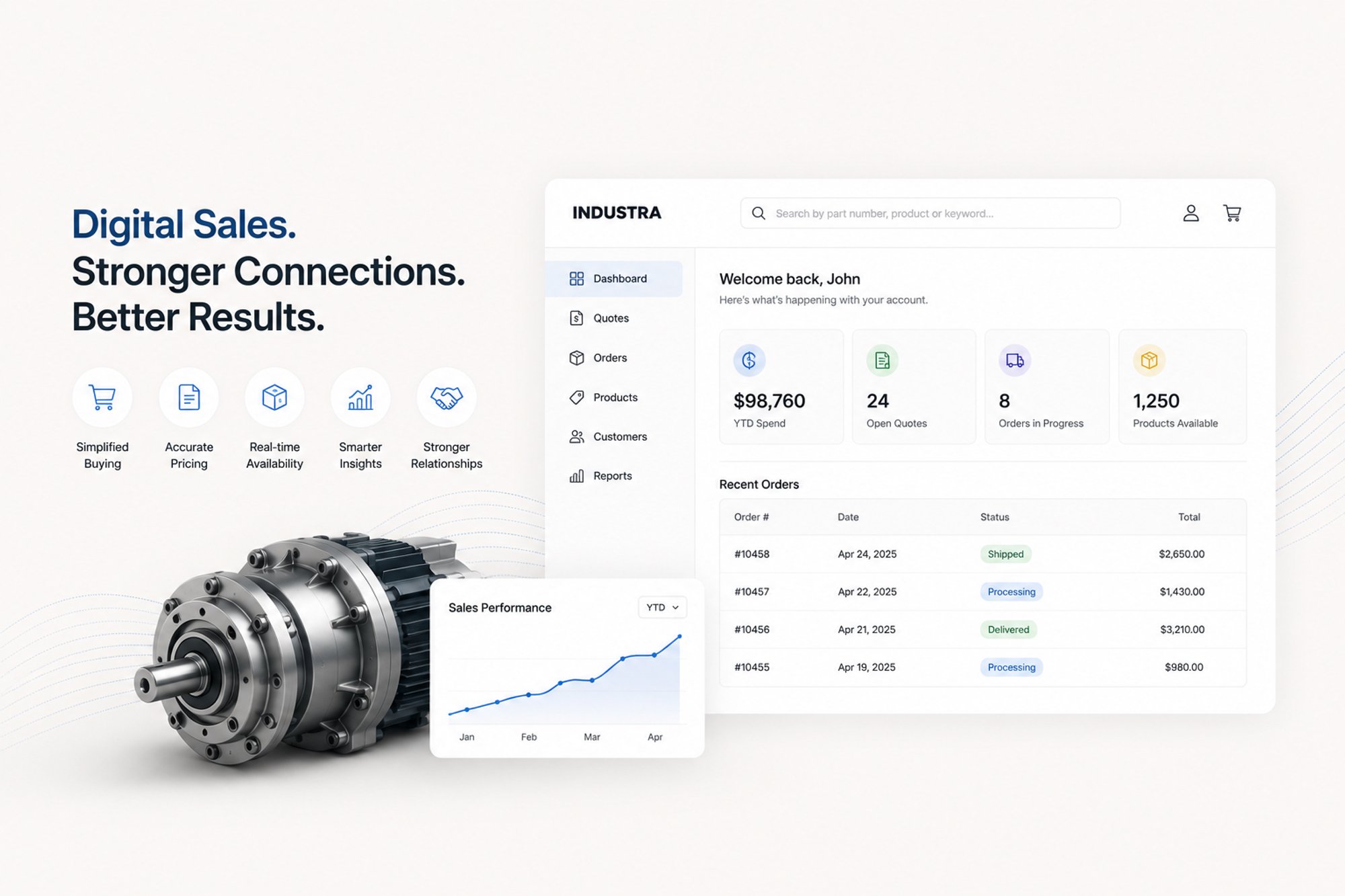
Manufacturers aren’t digitizing sales because relationships suddenly stopped mattering. They’re doing it because customers want a better way to reach the relationship. Read more.
Why Manufacturers Are Digitizing Their Sales Process: 7 Changes Driving Modern B2B Commerce
Manufacturing sales hasn’t suddenly become less relationship-driven.
What has changed is when the relationship starts.
A buyer may spend days researching products, comparing specifications, checking compatibility, downloading documentation, and narrowing down options before anyone on the sales team knows they exist.
By the time they reach out, they often expect to be much further along.
That’s a big reason manufacturers are investing in digital commerce. It’s not necessarily about replacing salespeople with a website. It’s about giving customers better ways to do the parts of the buying process they’re perfectly capable of doing themselves.
At Makro, we see this come up often in Shopify Plus projects. The companies making the strongest transition to digital usually aren’t trying to automate everything. They’re figuring out where technology can remove unnecessary friction and where human expertise still matters.
Here are seven changes pushing that shift forward.
1. The sales conversation starts before sales gets involved
For years, manufacturers could assume that an interested customer would call, email, or submit an inquiry fairly early in the process.
That assumption is getting harder to make.
Engineers, procurement teams, distributors, and other B2B buyers increasingly want to investigate their options first.
They may want to understand:
- What products are available
- Which models meet their requirements
- How two options differ
- Whether documentation is available
- What certifications apply
- Whether a part is compatible with an existing system
If the website doesn’t answer those questions, the buyer doesn’t always pick up the phone.
Sometimes they keep looking elsewhere.
That makes the digital experience part of the sales process whether a manufacturer intended it to be or not.
2. Self-service is moving from a convenience to an expectation
Not every customer interaction needs a salesperson.
A returning customer who needs to download a spec sheet, check an order, reorder a familiar part, or confirm a product dimension probably doesn’t want to wait for someone to email them back.
They just want the answer.
That’s where self-service earns its value.
Customer accounts, order history, quick ordering, downloadable documentation, saved lists, product availability, and well-organized support content can remove a surprising amount of routine back-and-forth.
This doesn’t make the relationship less personal.
In many cases, it improves it.
Salespeople spend less time acting as human search engines and more time helping customers with decisions that actually require experience and judgment.
3. Product data is becoming part of the sales pitch
Manufacturers naturally spend a lot of time thinking about messaging.
But for many B2B buyers, the most persuasive content on the website isn’t a headline.
It’s the data underneath it.
Does the product meet the required specification?
Is it available in the right material?
Does it carry the correct certification?
Will it work with the equipment already installed?
What are the dimensions?
What’s the operating range?
When those answers are difficult to find, confidence drops quickly.
Good product data does more than populate a product page. It powers search, filters, comparisons, integrations, recommendations, and eventually the customer’s ability to make a decision.
That’s why product information architecture often deserves just as much attention as the website design itself.
4. Manufacturers can finally see more of the buying process
Traditional B2B sales can leave a large part of the customer journey invisible.
You know when a prospect calls.
You know when someone requests a quote.
But what happened before that?
Digital commerce gives manufacturers more clues.
You can start seeing which products people search for, which categories receive attention, what documentation gets used, where customers abandon the journey, and which paths eventually lead to inquiries or purchases.
None of that data is particularly useful on its own.
The value comes from the questions it helps you ask.
Why are customers repeatedly searching for something they can’t find?
Why does one category generate a lot of traffic but very few inquiries?
Why are buyers leaving a particular product page?
Which existing customers are consistently returning to the same products?
Used well, ecommerce data becomes a feedback loop for sales, marketing, merchandising, and product teams.
5. Sales can spend more time actually selling
There’s a long list of things highly skilled salespeople probably shouldn’t spend their day doing.
Sending the same PDF for the fiftieth time.
Looking up basic product specifications.
Checking whether a standard replacement part exists.
Answering routine order-status questions.
Manually recreating information that could have been available online.
Some of that work will always be part of customer service. But when too much of it lands with sales, it takes time away from the conversations where a salesperson adds the most value.
Complex applications.
Large accounts.
Custom configurations.
Commercial negotiations.
New opportunities.
Strategic relationships.
A strong digital sales experience creates a better division of labor: the website handles straightforward information and transactions, while the sales team handles judgment, expertise, and relationships.
6. Ecommerce can't sit off on an island anymore
Launching an online storefront is one thing.
Making it work with the rest of the business is another.
Manufacturers typically have critical information living across ERP platforms, inventory systems, CRMs, product databases, fulfillment systems, and sometimes decades of custom software.
Customers don’t care where that information lives.
They simply expect the experience to make sense.
If inventory says one thing and the website says another, that’s a problem.
If customer pricing exists in the ERP but disappears online, that’s a problem.
If online orders create additional manual work instead of reducing it, something has gone wrong.
That’s why integration planning has become such an important part of manufacturing ecommerce.
Shopify Plus can serve as the commerce layer, but the strongest implementations are designed around the wider technology ecosystem from the beginning.
7. There really isn't a “finished” version of digital commerce
This may be the biggest mindset change.
Traditional website projects often have a finish line.
Launch the new site. Check the box. Move on.
Commerce doesn’t work particularly well that way.
Once customers begin using the experience, you start learning things you couldn’t know during the design process.
Maybe buyers search differently than expected.
Maybe a filter nobody thought was important becomes one of the most heavily used.
Maybe customers keep abandoning a particular step.
Maybe the documentation everyone assumed was essential barely gets opened, while another resource becomes critical.
That information should shape what happens next.
The best digital commerce programs become iterative.
Launch.
Observe.
Learn.
Improve.
That process may be less exciting than a giant transformation announcement, but it’s usually where the meaningful gains come from.
Before Digitizing Your Sales Process, Look at These Five Things
Technology decisions matter, but they shouldn’t be the first decisions.
1. Understand how customers buy today
Map what happens from the first research session through purchase and reorder.
Include the awkward parts.
Especially the awkward parts.
Those are often where the biggest opportunities are hiding.
2. Get serious about product data
Before building advanced search, filtering, or automation, make sure the underlying information is accurate and structured consistently.
Bad data with a beautiful interface is still bad data.
3. Identify the systems ecommerce needs to talk to
ERP, CRM, inventory, PIM, fulfillment, customer accounts, pricing—the exact stack will vary.
What matters is understanding those dependencies early instead of discovering them halfway through implementation.
4. Design around the customer, not the org chart
Your internal workflow may have taken twenty years to develop.
That doesn’t mean customers should have to experience all twenty years of it.
The digital experience should simplify what buyers see, even when a lot is happening behind the scenes.
5. Decide what success actually means
Traffic is useful.
It’s rarely the whole story.
You may care more about product discovery, qualified inquiries, account adoption, repeat purchases, reduced service requests, quote volume, conversion, or revenue from existing customers.
Define that before launch so you know whether the transformation is actually working.
Frequently Asked Questions
Will digital commerce replace manufacturing sales teams?
Usually, no.
For complex B2B purchases, knowledgeable salespeople remain extremely valuable.
Digital commerce is better suited to removing routine friction: helping customers research, find information, reorder known products, and handle straightforward transactions without unnecessary assistance.
That gives sales more time for the conversations where their expertise matters.
Why are manufacturers using Shopify Plus?
Shopify Plus is attractive to manufacturers because it can support scalable commerce while integrating with a broader business technology stack.
Depending on the implementation, manufacturers can use it for B2B commerce, direct-to-consumer sales, customer-specific experiences, self-service purchasing, and connections to ERP, inventory, CRM, and other systems.
The platform matters, but how it’s architected matters more.
Where should a manufacturer start with digital transformation?
Start with the customer journey.
Look at how buyers currently research products, request information, compare options, place orders, and reorder.
Then identify the parts of that journey that create unnecessary work or frustration.
Technology should solve those problems—not become the project for its own sake.
The Bigger Shift
Manufacturers aren’t digitizing sales because relationships suddenly stopped mattering.
They’re doing it because customers want a better way to reach the relationship.
They want to research without waiting.
They want useful product information without asking for it.
They want routine transactions to be routine.
And when they do need a salesperson, they want the conversation to begin somewhere beyond, “Can you send me the spec sheet?”
That’s where modern B2B commerce works best.
The website handles what technology is good at.
The sales team handles what people are good at.
And the customer gets a much easier buying experience in between.
See how that approach came together in Makro’s NewPro Containers case study, where Shopify Plus helped create a more modern digital sales experience for a manufacturing business.