
7 Shopify Plus Features Every Manufacturer Should Consider Before Their Next Website Redesign
A lot of manufacturing website redesigns start with the wrong question.
Teams ask, “What new features should we add?”
A better question is, “What is making it harder for customers to buy from us today?”
That changes the conversation.
A manufacturer with a large technical catalog does not need features for the sake of looking sophisticated. Engineers, procurement teams, distributors, and repeat customers are usually trying to do something fairly specific: find the right product, confirm that it will work, get the information they need, and move forward.
Shopify Plus gives manufacturers a lot of flexibility. But flexibility only matters when it is applied to real buying problems.
At Makro, that is generally how we think about feature planning. Start with the friction. Then decide which capabilities are actually worth building.
Here are seven that tend to matter most.
1. Search should understand more than product names
For an industrial buyer, search can be one of the most important parts of the site.
They may not know your official product name.
They may know the part number.
Or the old part number.
Or the voltage.
Or an abbreviation everyone in the industry uses but nobody on your marketing team thought to put in the navigation.
That is why manufacturing search needs to be designed around how people actually look for products.
A strong search experience can account for things like:
- Part numbers
- Legacy SKUs
- Technical abbreviations
- Product attributes
- Industry terminology
- Common misspellings
- Replacement products
- Related terminology
This sounds simple until you have thousands of products.
Then search quality becomes much more dependent on the quality of the underlying product data.
Shopify Plus gives you the flexibility to build a strong search experience, but the technology is only one piece of it. If product information is inconsistent or badly structured, even a sophisticated search tool will struggle.
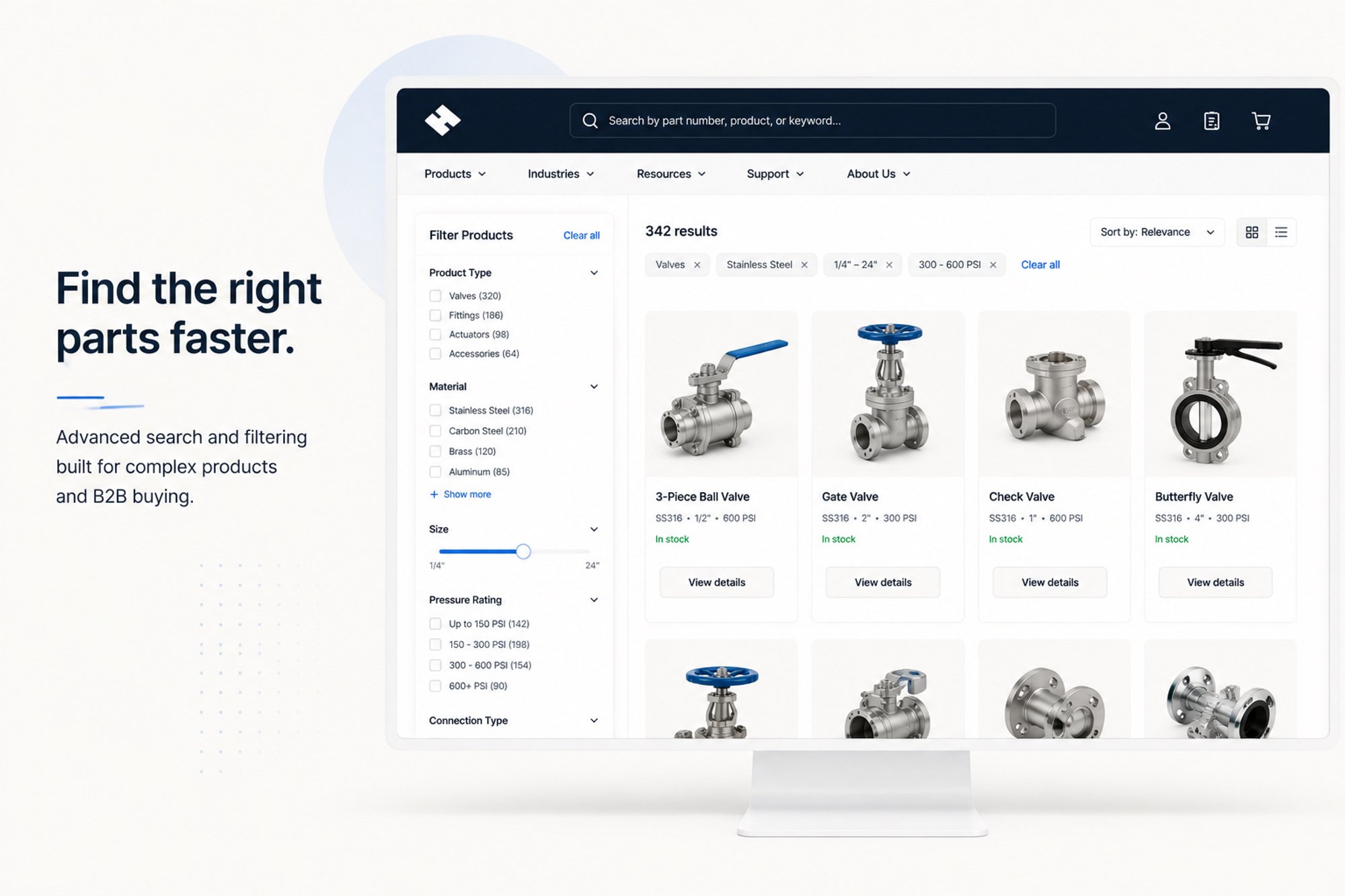
2. Filtering should help buyers eliminate the wrong products quickly
Search helps someone find a category of products.
Filtering helps them figure out which one they actually need.
That distinction matters.
Imagine a buyer looking at 150 products that appear almost identical at first glance.
Opening each product page individually is not a buying experience. It is an assignment.
The better approach is to let buyers narrow the catalog using the specifications they already care about.
That might include:
- Size
- Material
- Voltage
- Capacity
- Airflow
- Pressure
- Certification
- Application
- Industry
- Compatibility
The exact filters will depend on the business.
What matters is choosing attributes that actually help customers make a decision.
One of the easiest redesign mistakes is creating filters because the data exists rather than because customers use it.
Good filtering is selective.
It removes noise.
3. Product pages should behave more like decision tools
A technical product page has a different job than a typical consumer product page.
The buyer probably does not need more adjectives.
They need evidence.
They want to know whether the product fits the application, meets requirements, works with existing equipment, and can be installed or approved without creating another problem.
That means the page may need to bring together several different kinds of information:
- Technical specifications
- Data sheets
- Installation manuals
- Certifications
- CAD files
- Videos
- FAQs
- Related components
- Compatible products
- Replacement parts
- Accessories
The key is not simply having all of that information somewhere on the website.
It should be available where the decision is being made.
A useful product page answers enough questions that the customer can confidently decide what to do next.
Sometimes that next step is checkout.
Sometimes it is requesting a quote.
Sometimes it is calling an engineer.
All three can be successful outcomes.
4. B2B accounts should make repeat buying noticeably easier
A lot of manufacturing ecommerce is not about discovery at all.
It is about repetition.
A customer bought a product six months ago.
Now they need the same one again.
They may already know the part number, quantity, shipping location, and account terms.
That person should not have to repeat the same buying process from scratch.
Customer accounts can make a major difference here.
Depending on the business, useful functionality might include:
- Order history
- Reordering
- Saved carts
- Saved product lists
- Quick-order forms
- Account-specific catalogs
- Customer-specific pricing
- Invoices
- Multiple company locations
- Purchasing permissions
This is one of those areas where a relatively unglamorous feature can have an outsized impact.
Nobody is going to post a LinkedIn screenshot celebrating a good reorder workflow.
The customer who just saved fifteen minutes will still appreciate it.
5. Shopify Plus needs to work with the systems behind the website
A commerce platform cannot create a good customer experience if the information behind it is unreliable.
Inventory.
Pricing.
Customer accounts.
Order status.
Product details.
Fulfillment.
Those pieces often live somewhere else.
For manufacturers, that usually means Shopify Plus has to connect with systems such as ERP, CRM, PIM, inventory, warehouse, or fulfillment platforms.
This is where redesign projects can become more complicated than they first appear.
The storefront might look straightforward.
The real question is what needs to happen after somebody clicks “Buy.”
Does the order flow into the ERP?
Does inventory update correctly?
Does account pricing carry over?
Do customer records stay synchronized?
Can fulfillment work without someone manually re-entering the order?
Those are not back-office details.
Eventually, they become customer-experience issues.
A clean storefront connected to messy operations is still a messy ecommerce experience.
6. Content should help customers make decisions, not just bring in traffic
Manufacturers often think about content primarily through the lens of SEO.
That is useful, but it is only half the opportunity.
Content can also help buyers answer questions that product pages are not designed to answer.
Think about the questions someone asks before narrowing down to a particular SKU.
“What type of product do I need?”
“What is the difference between these two technologies?”
“Which option works best in this environment?”
“What specification should I be looking at?”
That is where buying guides, comparison pages, application content, industry resources, and educational articles become useful.
The strongest content sits naturally between marketing and sales.
It attracts the right audience, but it also helps that audience make progress.
That is a much better benchmark than publishing articles simply because the content calendar says Tuesday.
7. Build the site expecting it to change after launch
A website redesign often gets treated like the finish line.
It should probably be treated more like the starting point.
Once real customers start using the new experience, they will show you what you got right and what you did not.
Search data may reveal terminology you overlooked.
Analytics may show that customers rarely use a feature everyone assumed would be important.
Support tickets may expose missing information.
A product category may behave completely differently than expected.
That is useful information.
The best Shopify Plus programs create room for continued improvement rather than trying to predict every possible need during the original build.
Launch the best version you can.
Then watch how people use it.
That is where optimization becomes much more grounded.
Before Choosing Features, Ask These Five Questions
A feature roadmap gets much easier when every idea has to earn its place.
1. What customer problem does this solve?
If the answer is vague, the feature probably needs more thought.
“Competitors have it” is not a customer problem.
2. Does it remove work or create more of it?
Some features look convenient for customers but quietly create a new manual process for employees.
Look at both sides of the workflow.
3. Does it help someone find, evaluate, or buy a product?
Most manufacturing ecommerce functionality should contribute to at least one of those things.
If it does not, ask why it is a priority.
4. Will it still work when the catalog gets bigger?
A solution that works nicely for 200 products may become painful at 20,000.
Think about product data, administration, integrations, and maintenance before committing to the experience.
5. How will we know it worked?
Define that before the feature launches.
Success might mean fewer search exits, more repeat orders, fewer support requests, higher account adoption, better conversion, faster ordering, or more qualified inquiries.
The metric should match the problem.
Frequently Asked Questions
Is Shopify Plus a good fit for complex manufacturing businesses?
It can be.
Shopify Plus can support large catalogs, B2B commerce, customer accounts, integrations, product discovery, and sophisticated buying experiences.
The bigger question is whether the implementation has been designed around the complexity of the business.
Platform capability matters.
Architecture matters more.
Which Shopify Plus feature tends to make the biggest difference first?
For manufacturers with large catalogs, improving search and filtering can often produce noticeable gains quickly because product discovery affects almost everything that happens afterward.
But there is no universal first feature.
If customers can already find products easily but your team spends hours manually processing repeat orders, account functionality may have a much bigger impact.
Start with the biggest source of friction.
Should every manufacturer use the same feature set?
Definitely not.
A company selling configurable equipment has different needs from one selling replacement parts.
A distributor has different needs from a manufacturer selling direct.
A business with negotiated account pricing has different needs from one with public pricing.
The feature set should follow the buying model, not a generic B2B ecommerce checklist.
The Bigger Point
The best manufacturing website is not the one with the longest feature list.
It is the one that makes the difficult parts of buying feel easier.
Search should help customers get oriented.
Filters should reduce the number of choices.
Product pages should answer technical questions.
Accounts should make repeat buying faster.
Integrations should keep the experience accurate.
Content should help buyers think.
And the site should keep getting better once real customers begin using it.
That is where Shopify Plus becomes most valuable.
Not as a collection of features, but as a platform for building a commerce experience around how your customers actually buy.
See how that thinking was applied in Makro’s NewPro Containers case study, where Shopify Plus supported a more modern manufacturing e-commerce experience.