
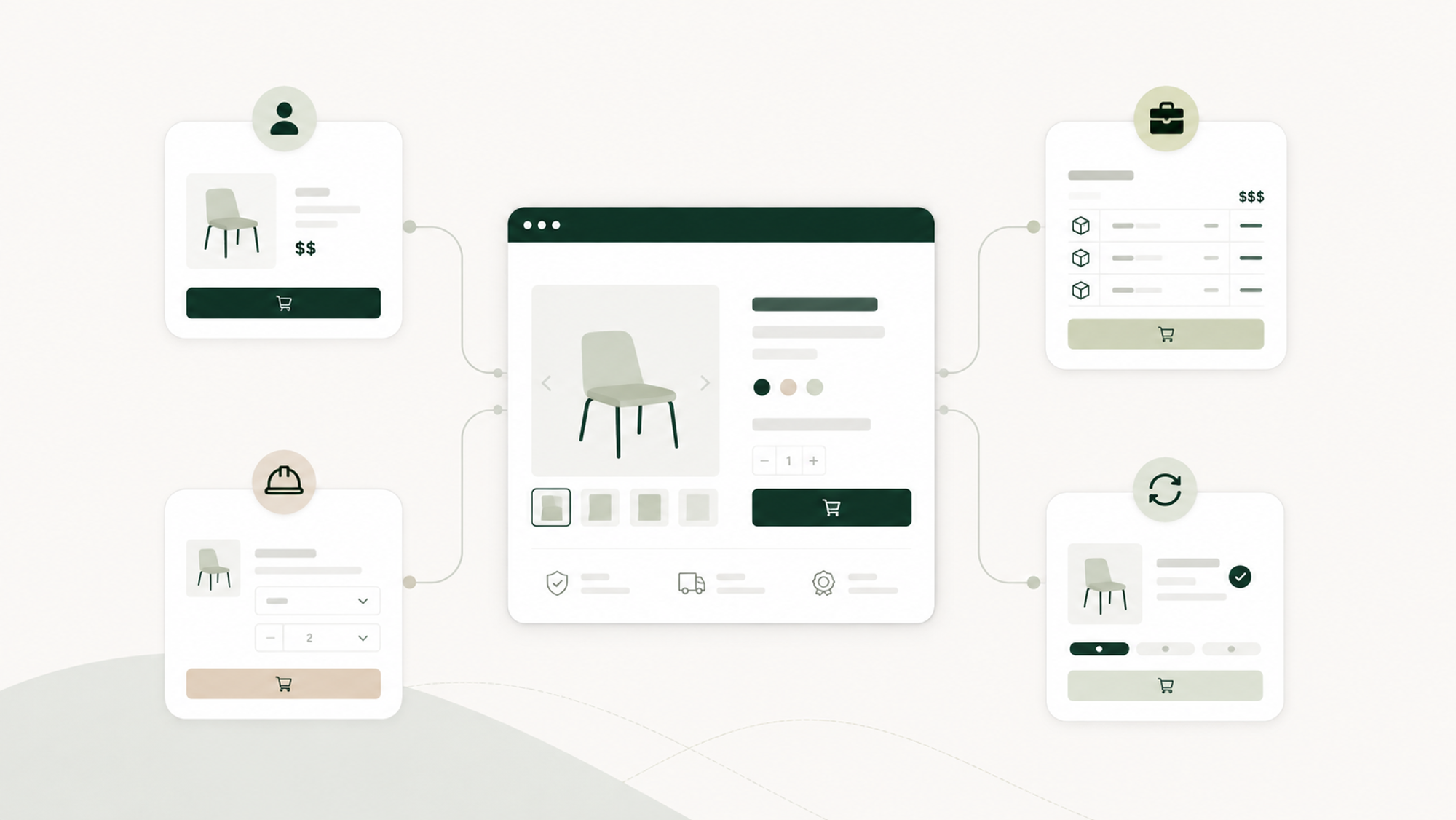
If your business serves more than one type of customer, you do not necessarily need more storefronts. Learn more.
How to Design Shopify Plus for Multiple Buyer Journeys
Are you serving multiple customer types in Shopify, but finding that they need different information, pricing, or purchasing paths?
That is a common challenge as ecommerce businesses grow.
As e-commerce brands grow, one customer journey often becomes several.
You may be selling to consumers, wholesale buyers, professionals, repeat customers, distributors, or regional markets that all interact with the same product catalog differently.
Those customers may need different:
- product information
- pricing
- account experiences
- ordering workflows
- content
- navigation
- checkout options
The challenge is not simply creating more customer experiences.
It is building a Shopify Plus architecture that supports those differences without creating a fragmented commerce operation underneath them.
Why Do Growing Brands Need More Than One Buyer Journey?
A direct-to-consumer customer may want to understand product benefits, compare options, and check out quickly.
A wholesale buyer may need volume pricing, account-specific catalogs, purchasing rules, or faster repeat ordering.
A professional buyer may need technical specifications, certifications, documentation, or deeper product education.
A repeat customer may simply want to get back to products they already know and reorder with minimal friction.
Those are different buying behaviors.
Trying to force all of them through the same experience can make the storefront less useful for everyone.
The better approach is to identify where customer journeys should be shared and where they should be different.
How Can You Simplify Multiple Buyer Journeys in Shopify Plus?
The goal is not to create a separate ecommerce experience for every customer type.
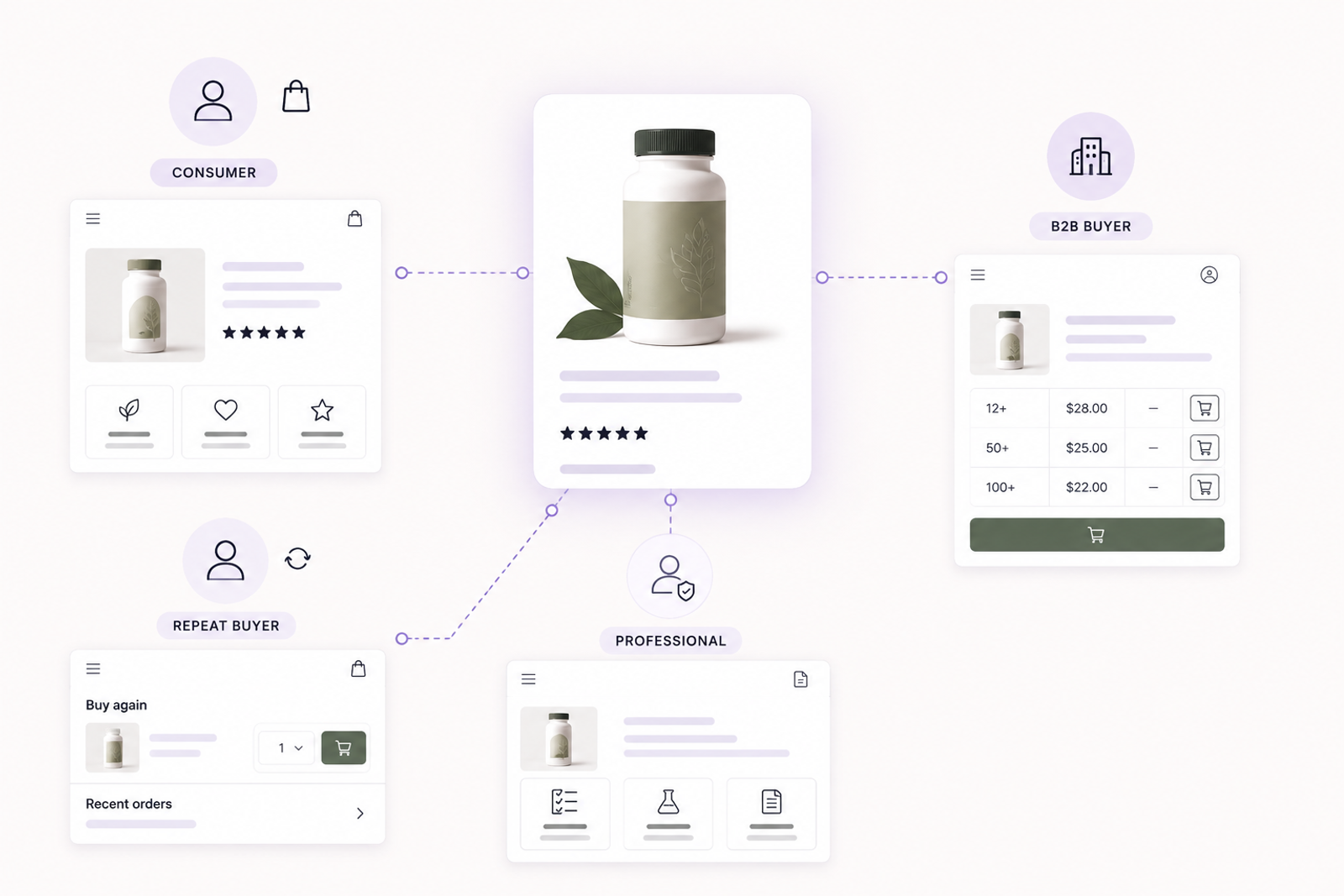
It is to give each buyer the information and functionality they need while keeping the underlying commerce ecosystem manageable.
Here are five ways we can help.
1. Show Different Buyers the Information That Matters to Them
Different customer types often need different levels of product information.
A consumer may care about benefits, use cases, reviews, and product comparisons.
A professional buyer may need technical documentation, certifications, specifications, or research.
A wholesale customer may care more about pack sizes, availability, ordering requirements, and pricing.
We can structure Shopify so the same product data supports different customer experiences.
Using metafields, metaobjects, customer data, and custom storefront logic, we can surface relevant information without duplicating the entire product catalog.
That creates a more personalized experience while keeping the data model centralized.
2. Give B2B Buyers the Purchasing Tools They Actually Need
B2B ecommerce becomes difficult when wholesale customers are expected to shop like consumers.
The buying journey may require more than an add-to-cart button.
Depending on the business, buyers may need:
- company accounts
- customer-specific catalogs
- negotiated pricing
- quantity rules
- volume pricing
- payment terms
- quick ordering
- repeat ordering
- account-specific purchasing workflows
Shopify Plus gives us the foundation to build these experiences around the way B2B customers actually purchase.
The goal is to make ecommerce support the buying process rather than asking the customer to work around the platform.
3. Guide Customers Into the Right Journey Earlier
When one storefront serves several audiences, navigation becomes part of the architecture.
Customers should not have to understand your internal business structure to know where to go.
We can create clearer entry points around questions like:
- Who are you buying for?
- What are you trying to accomplish?
- Are you purchasing for yourself or for a business?
- Do you already have an account?
From there, the experience can guide customers toward the right products, content, account environment, or ordering flow.
For complex e-commerce businesses, good UX is often about helping customers avoid irrelevant paths.
4. Keep Shared Commerce Data in One Scalable System
One of the biggest risks of supporting multiple customer types is solving every new requirement with another disconnected storefront.
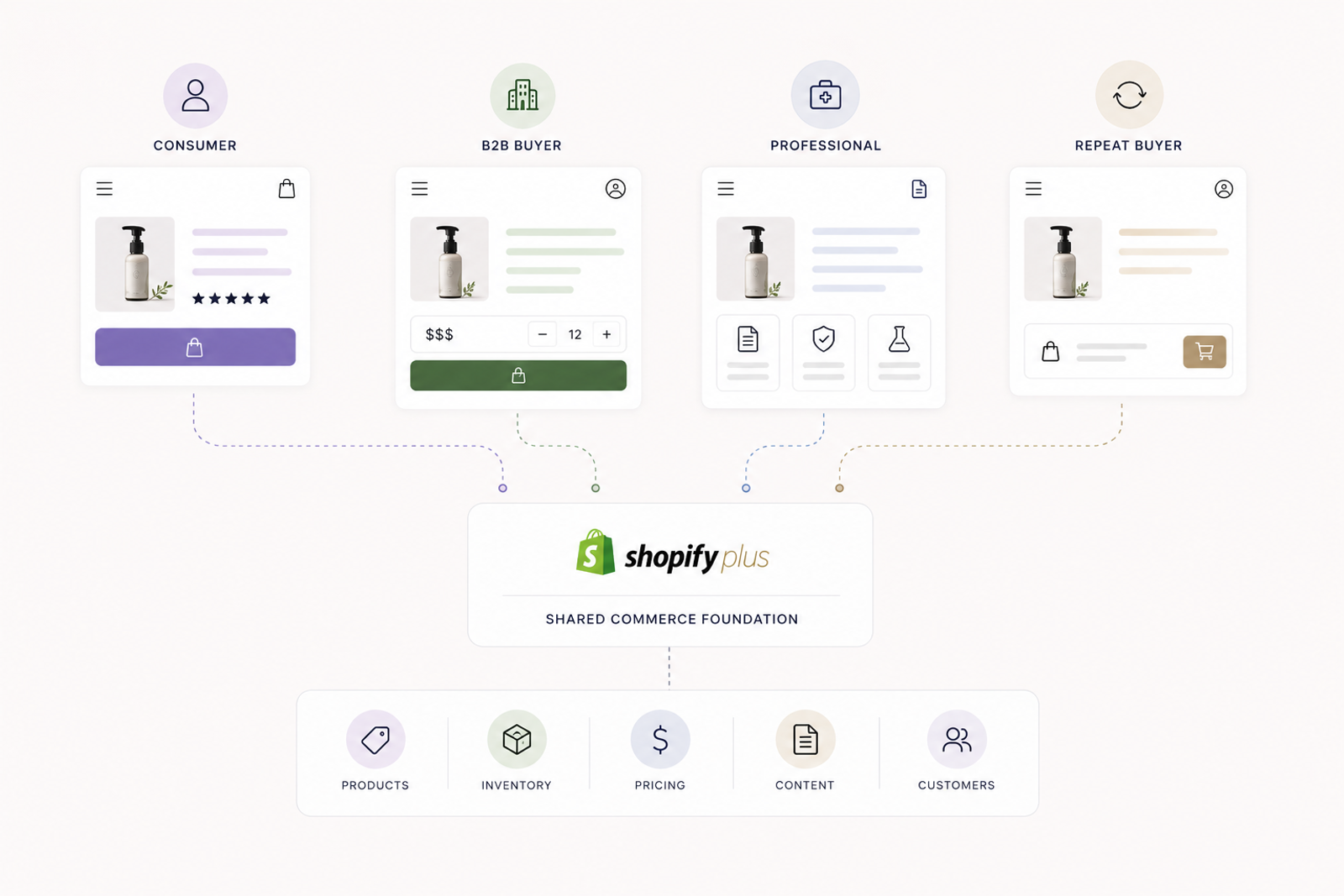
That can quickly create duplicated:
- product information
- inventory
- content
- integrations
- pricing logic
- reporting
- maintenance
- development work
Where the business requirements allow it, we can keep shared commerce data centralized while changing the experience around it.
The same product can support different:
- content
- pricing
- catalogs
- ordering rules
- educational information
- merchandising
depending on who is buying.
That gives the business more flexibility without multiplying the systems behind the storefront.
5. Build Custom Journeys When Standard Shopify Flows Are Not Enough
Some businesses have purchasing journeys that do not fit neatly into an out-of-the-box ecommerce flow.
You may need:
- custom account experiences
- approval workflows
- specialized product access
- customer-specific ordering rules
- proprietary pricing logic
- customer segmentation
- external system integrations
- custom B2B workflows
That is where custom Shopify Plus development becomes useful.
We can extend the platform around the parts of the buying journey that are unique to your business while keeping standard Shopify functionality where it already works well.
The objective is not to customize everything.
It is to introduce custom logic where it solves a real customer or operational problem.
How Do You Know When Buyer Journeys Should Be Separate?
Not every customer segment needs its own storefront.
Before separating experiences, it helps to ask:
- Do these customers need a different catalog?
- Do they need different pricing?
- Do they follow a different purchasing workflow?
- Are product data and inventory shared?
- Is the content fundamentally different?
- Are there regional, legal, or operational reasons to separate the experience?
If most of the underlying commerce requirements are shared, the better solution may be one Shopify Plus foundation with differentiated experiences layered on top.
If the business rules are fundamentally different, a more separated architecture may make sense.
The important part is making that decision intentionally.
How Can Shopify Plus Support Future Buyer Segments?
A scalable ecommerce architecture should not only solve today's customer journeys.
It should make the next one easier to add.
That means thinking ahead to possibilities like:
- launching wholesale
- adding a distributor portal
- introducing a professional buyer experience
- expanding into a new market
- adding customer tiers
- creating subscription journeys
- introducing new pricing models
If every new segment requires rebuilding the storefront from the ground up, the platform becomes harder to scale.
A stronger Shopify Plus foundation uses reusable data structures, modular components, customer segmentation, and flexible commerce logic so future journeys can build on what already exists.
What Does This Look Like in Practice?
Bio-K+ needed to support customers with different levels of product knowledge.
Some customers were everyday consumers trying to understand which probiotic product was right for them.
Others, including healthcare professionals, needed deeper information about strains, formulations, and product benefits before making a recommendation or purchase.
We built the Shopify Plus experience so product education could support those different needs without making the storefront unnecessarily complicated.
The experience connected product information, education, discovery, and purchasing within one commerce journey while giving different customers access to the level of detail they needed.
How Do You Build Shopify Plus Around the Way Your Customers Actually Buy?
If your business serves more than one type of customer, you do not necessarily need more storefronts.
You need an ecommerce architecture that understands where customer journeys should be shared and where they need to differ.
That means bringing together:
Customer segments.
Product data.
Pricing.
Content.
Navigation.
Purchasing workflows.
Custom functionality.
When those pieces are designed together, Shopify Plus can support multiple buyer journeys without creating unnecessary complexity behind the scenes.
Need Shopify Plus Built Around Multiple Buyer Journeys?
We help growing brands design and develop Shopify Plus experiences around the real differences between their customers, products, and purchasing workflows.
See how we helped Bio-K+ create a clearer ecommerce experience for customers with different levels of product knowledge.