
6 Ways Manufacturers Can Make Complex Products Easier to Buy Online
Manufacturing ecommerce has an interesting problem: the products may be complicated, but the buying experience doesn’t have to be.
A customer looking for an industrial ventilation system, replacement component, or piece of specialized equipment is rarely casually browsing. They usually have a problem to solve, specifications to meet, and questions they need answered before they can move forward.
That changes how a manufacturing website should work.
The goal isn’t to make a technical catalog feel like a consumer storefront. It’s to take complexity that already exists in the buying process and organize it in a way that makes sense to the buyer.
That distinction matters.
We see it often in Shopify Plus projects at Makro. Manufacturers can have strong products, experienced sales teams, and thousands of SKUs, but still make customers work much harder than necessary to figure out what they need.
Here are six places we typically look first.
1. Organize the catalog around how customers actually shop
One of the easiest mistakes to make is organizing a website around the company itself.
Internally, your products may belong to different divisions, product families, engineering groups, or business units. That structure makes perfect sense to the people who work there every day.
Your customer may have no idea it exists.
They’re more likely thinking:
What works for this application?
Which model meets this specification?
What replaces the part I already have?
Which products are approved for my industry?
That’s the logic your ecommerce experience should follow.
Strong manufacturing navigation often gives buyers several paths into the catalog: by product type, application, industry, specification, or even part number.
The easier it is for someone to recognize their own problem in your navigation, the less explanation your sales team has to provide later.
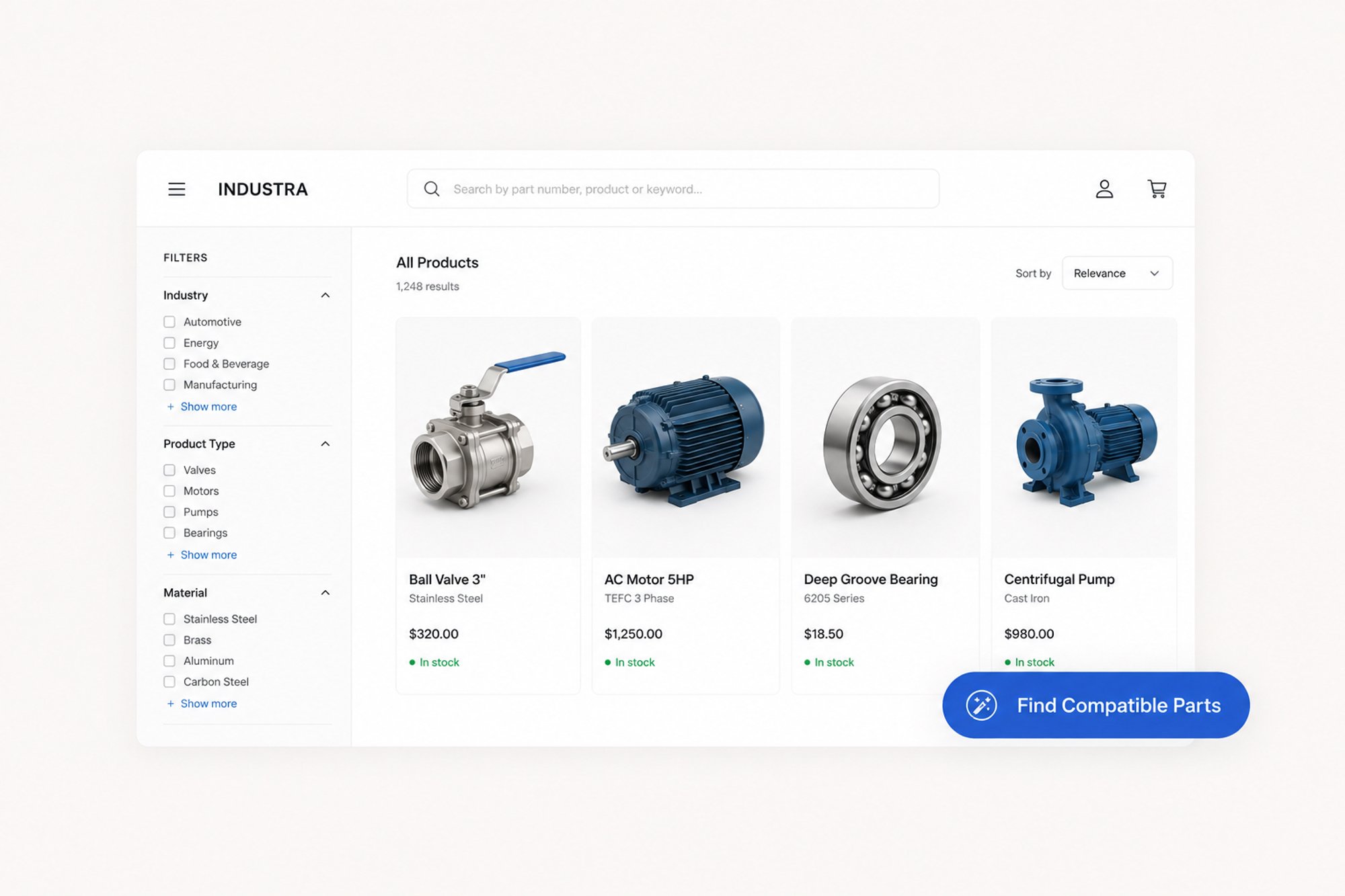
2. Turn technical specifications into useful filters
Filters become much more important when products are highly similar.
If you sell ten T-shirts, filtering is convenient.
If you sell 2,000 components with different dimensions, materials, voltages, capacities, certifications, and operating conditions, filtering is part of the buying process.
A buyer shouldn’t have to open fifteen product pages just to discover which five products meet their requirements.
Think about the information customers normally use to narrow a decision. Depending on the product, that could include:
- Dimensions
- Material
- Airflow
- Voltage
- Capacity
- Pressure
- Certification
- Compatibility
- Application
- Industry
Those attributes shouldn’t only exist inside a specification sheet. When possible, they should help power product discovery.
This is also where thoughtful Shopify architecture matters. Product data has to be structured consistently before filters, search, comparisons, and integrations can work well together.
3. Build product pages around the buyer’s next question
A good product page shouldn’t simply describe the product.
It should anticipate what someone will want to know next.
For a technical buyer, that might mean:
“Will this work with the system I already have?”
“Where is the installation guide?”
“Does this meet the certification my project requires?”
“What’s the difference between this model and the one above it?”
“Can I download the CAD file?”
You want those answers close to the decision, not buried somewhere else on the site.
Depending on the product, that may mean including specifications, drawings, installation manuals, certifications, FAQs, related accessories, replacement parts, compatibility information, videos, or downloadable documentation directly on the page.
There’s a simple principle behind this: every unanswered question creates friction.
Some questions will always require sales or engineering support. That’s fine. The website should simply handle everything it reasonably can before that conversation begins.
4. Make search understand the language your customers use
Industrial buyers don’t always search using your official product names.
They search for old part numbers.
Abbreviations.
Competitor terminology.
Internal nicknames.
Misspellings.
Model numbers from equipment that may have been installed fifteen years ago.
That’s why a basic site search can become frustrating very quickly on a manufacturing website.
Search needs context.
If an old SKU has been replaced, the buyer should be directed toward the new one. If two terms mean essentially the same thing in the industry, your search experience should understand the relationship.
This is an area where the right Shopify Plus search solution can make an enormous difference, particularly for large catalogs.
The best search experiences don’t force customers to learn your terminology first.
They meet buyers where they already are.
5. Make product comparison easier than opening five browser tabs
Technical buyers compare.
That part isn’t going away.
The question is whether your website helps them do it or leaves them to build their own comparison process.
If two products look nearly identical but differ in operating range, material, dimensions, or certification, those differences should be easy to see.
Side-by-side comparison tables are useful because they reduce the amount of information a buyer has to hold in their head.
But comparison doesn’t always require a dedicated comparison tool.
Sometimes good product naming, clearly structured specifications, helpful category pages, and concise “best for” descriptions solve most of the problem.
The objective is the same either way: make the meaningful differences obvious.
Your customer shouldn’t need an engineering degree just to understand why Product A costs more than Product B.
They may already have an engineering degree. You still shouldn’t make them work that hard.
6. Remember that many customers aren't discovering products at all
A lot of ecommerce advice assumes every visitor is shopping.
Industrial ecommerce is different.
Your returning customer may already know exactly what they need.
They’ve ordered it twelve times.
They have the part number.
They just want ten more.
For that customer, elaborate discovery features matter much less than speed.
That’s where saved lists, customer-specific catalogs, order history, quick-order forms, account pricing, reorder functionality, and efficient checkout can become extremely valuable.
The first purchase and the fiftieth purchase are different experiences.
Your website should recognize that.
For many manufacturers, improving repeat purchasing can be just as important as improving product discovery because existing customers often represent a significant share of ecommerce activity.
Before Redesigning Your Manufacturing Website, Ask These Four Questions
You don’t necessarily need to begin a redesign by talking about layouts, colors, or even Shopify features.
Start with the buying process.
1. Where do customers get stuck today?
Look at support tickets, sales conversations, search behavior, analytics, and feedback from customers.
Patterns usually emerge quickly.
2. What information does sales repeatedly have to provide?
If customers ask your team the same question every week, there’s a good chance the website should be answering it.
3. Can a knowledgeable buyer find the right product without contacting you?
They don’t necessarily need to complete the entire transaction online.
But they should be able to make meaningful progress on their own.
4. Does the site reflect the customer's mental model or yours?
This is often the most important question of the four.
Internal structure has a way of quietly finding its way into navigation, categories, terminology, and content.
A redesign is an opportunity to correct that.
Frequently Asked Questions
Can Shopify Plus handle highly technical B2B products?
Yes. The challenge is usually less about whether Shopify Plus can display technical products and more about how the underlying product data and buying experience are structured.
For complex catalogs, product architecture, metafields, search, filtering, integrations, customer accounts, pricing logic, and technical content all need to work together.
Should manufacturers show pricing online?
There isn’t one right answer.
Some manufacturers publish pricing across the entire catalog. Others show pricing only to logged-in customers, use customer-specific pricing, or keep certain products quote-based.
The better question is what information buyers need in order to confidently take the next step.
Even when pricing can't be public, the site can still provide considerably more buying information than many manufacturers do today.
Does mobile really matter for industrial ecommerce?
Yes, although the use case may look different from consumer ecommerce.
A customer may pull up a product page from a warehouse, job site, production floor, meeting, or piece of equipment they’re standing beside.
That means technical information, search, documentation, and navigation should still be easy to use on a phone.
The Bigger Idea
Making complex products easier to buy online doesn’t mean removing the complexity from the product.
It means deciding which parts of that complexity the customer actually needs to deal with.
Good manufacturing ecommerce does a lot of that work quietly.
It organizes the catalog.
It surfaces the right specifications.
It explains meaningful differences.
It remembers returning customers.
And it gives buyers enough information to move forward without constantly stopping to ask for help.
That’s ultimately what a strong Shopify Plus implementation should do: not turn manufacturing into consumer ecommerce, but create a buying experience that actually fits the way industrial customers make decisions.
See how Makro approached a real industrial e-commerce implementation in our FUMEX case study.